Wednesday, August 15, 2018

Democracy in the Classroom

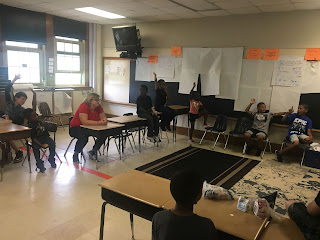
Because we believe in empowering kids, we give the students decision making power.  Every day during morning meeting, students have the opportunity to make a suggestion.  Once a suggestion has been made, the students have to come up with three reasons to accept the proposal.  They also have to come up with reasons to reject the proposal.  Once we've thought about these reasons on both sides, we have a vote.

This summer, students have voted to have some craft activities (melting beads, slime) and to change the way we line up when going to another activity (recess, lunch, gym, computer lab).  We've also seen kids settle disputes among themselves by voting.  "Let's vote!" is shouted whenever there is a decision to be made.  To be honest, "Let's do rock, paper, scissors!" is also shouted.  Sometimes we have to vote about whether to decide by vote or by the rock, paper, scissors game!  In any case, the students are enjoying the power of the vote.  Let's hope they hold on to that as they get older!
Students voting during morning meeting

Adding craft activities, deciding to join other classes on a field trip to the farmer's market, and having a daily line leader are all fairly easy decisions that the students have made.  However, during week three, we hit a major problem as students let their voices be heard about one of the bed rocks of the LEAP program -- Book Club.  During morning meeting, a student suggested we stop having Book Club -- the reason?  It's boring, we were told.  This happened as we had moved into longer chapter books and the kids were wishing they didn't have to read the same book day after day.  (Earlier books had been completed in one or two days.)  What to do?  We had told the students we valued what they had to say -- and they had a major critique.

In the end, we gave them a limit.  We needed to do something that encouraged their reading and writing.  We are here to improve literacy skills.  So that was a hard limit -- any suggestions they had about what we could do during Book Club would be taken seriously, as long as they promoted reading and/or writing.

Each child sat down and wrote me a letter suggesting improvements to Book Club and giving reasons that their suggestion would be good and would promote literacy.  Some kids asked that we leave Book Club as it is -- no changes!  It's fun as it is.  Other kids had suggestions about writing their own book or reading a book and then turning it into a play.  Fortunately, we have three teachers in the classroom, so we were able to make everyone happy.  Ms. Claire continued reading Junie B. Jones and that Meanie Jim's Birthday with the children who liked Book Club as it is.  Ms. Emily began to work with students who wanted to write their own graphic novel.  Last, a group of students worked with me to turn Stone Soup into a play.  They've taken the story and added their own ingredients -- including pizza, chocolate, and sweet coconut.
The cover of the graphic novel written by students

In the end, the students are more engaged because they are using their literacy skills the way they want to.  And they are still learning important literacy skills.  The two groups who created their own stories learned about the importance of a narrative arc and are writing their own unique ideas.

Perhaps even more important that the literacy skills that the children worked on, the value of hearing everyone's voices, negotiating for good solutions, giving reasons for their positions, and voting has become central to how the kids work through situations.  Here is one example: our trip to the Farmer's Market was delayed by rain.  When we went on the rescheduled day, some of the children had forgotten to bring money.  I had a small group -- four young men -- and gave each of them one dollar (which was all I had with me).  They bought some water (it was a hard day) and were down to two dollars when we reached the bakery booth.  Delicious, homemade cookies beckoned -- but they were four dollars for a package.  The kids huddled in front of the booth, discussed how they could pool their money and which treats they should buy.  One child didn't like chocolate, so they negotiated over whether to buy chocolate chip cookies (which only had small amounts of chocolate) or snickerdoodles.  They settled on the snickerdoodles, but were still in trouble, since they didn't have enough money for a full package of cookies.  The woman who ran the booth had overheard their discussion and was impressed by how they were working as a team, pooling their money, and trying to be fair to all -- so she sold them the four dollar package for two dollars!  I was so proud of how they had used democratic values to solve their problems -- and pleased that they got recognition for their efforts from someone outside the program.

Monday, July 23, 2018

Writing (and Reading) with purpose!


It’s our second week for the LEAP Program at Seymour Dual Language Academy and the kids are getting into the rhythm of our day. We integrate reading and writing for real purposes throughout the day so that kids will see that literacy matters.  


Students with Ms. Claire during breakfast
Students gather around Ms. Claire during breakfast.

Breakfast and Letter Writing

We begin the day with breakfast – a casual time during which friends reconnect. This is a time when children also write letters to one another and to their teachers, their parents, and others. (We had one child write a letter to the zoo after our field trip last week.)


A student mailing a letter in the class mailbox
A student mails a letter in our class mail box.  Later in the day, a democratically elected letter carrier (one of the kids!) will deliver the letters to their recipients.  Each letter is in an envelope, with a "stamp" in the upper right corner.  (We use stickers for stamps.)


Book Club

During book club, students read high quality trade paperbacks and discuss the stories and the writing done by the authors. When discussing Apt. 3, by Ezra Jack Keats, a student told me that he likes it when an author leaves it to the reader to figure out what is happening in a story or how a character is feeling, rather than just saying something. For example, when Sam lingers by Betsy’s door, this student figured out that Sam might have a crush on her – and he loved that Mr. Keats got that message across by describing Sam’s actions, rather than just saying, “Sam had a crush on Betsy.” Thinking this way about books will help our students be better writers themselves.


Book Club
Students read Jaden Toussaint, the Greatest: The Search for Screen Time in a book club.  Students are given the choice of three different books and pick the story that interests them the most.


Problem-Solving

As I mentioned in the previous post, the students are also working on solving some pretty big problems: the problem of bullying and the problem of gun violence. Again, the students write with a real purpose and use the letter format to convey their ideas. Students in the gun violence group are writing drafts of letters to our Senators and Representative. One child details in his letter the impact of gun violence in his own life. Let’s hope our government officials will listen to this passionate young people!


Student with letter to Sen. Schumer
A student poses with the beginning of his letter to Sen. Schumer, asking that AR-15s be banned.  Pride in their work makes us so happy!


Sunday, July 15, 2018

And we're off! Week One of the Summer Program

It's a delight to be back at Seymour Dual Language Academy with a curious group of kids working on reading, writing, and changing the world.  Each morning we have Book Club where children choose what book they would like to read in small groups and discuss.  We've already read a pile of books -- including Ling and Ting: Not Exactly the Same by Grace Lin, Apt. 3 by Ezra Jack Keats, Three Stories You Can Read to Your Dog by Sarah Swan Miller, Abuela's Birthday by Jacqueline Jules, The Boy Who Didn't Believe in Spring by Lucille Clifton, and Dancing in the Wings by Debbie Allen.  But by far the most popular book was This is Black Panther from Marvel.  The kids jumped into their Book Club discussion, comparing the book to the movie and imagining themselves as super heroes.   

And they are super heroes.  The children have picked two important problems in their community to tackle this summer: gun violence and bullying.  They spend the second half of the morning researching the causes of those problems and what solutions have already been tried.  As the summer continues, they will develop their own solutions to those problems and work to get their solutions enacted.  Stay tuned for details as their work progresses!
In addition to their work in Book Club and Problem Solving, the children are working to create a democracy in the classroom.  During Morning Meeting, they take turns being chair person, and facilitate discussions about future plans for the program.  So far, they have voted to use some time last Friday to make clay projects (they had a blast! – Pictures to come in the next blog post.)  They also voted that they will line themselves up alphabetically when they go out to recess or to lunch, each day moving the leader from the previous day to the end of the line.  They work for fairness in their decisions.

There is so much going on in the classroom that I didn’t have time to take a lot of pictures.  I did get pictures when we went to the Rosamond Gifford Zoo on Wednesday.  These are amazing kids, learning and growing in a hundred ways!  Here they are learning about the reticulated python.


Tuesday, May 15, 2018

Keeping it Real!

Working out is important
-- but it isn't the end goal!
Children do a lot of writing in school -- they fill out worksheets, answer reading comprehension questions, practice their spelling words.  Writing like this is similar to working out in a gym -- running in place on a treadmill, lifting heavy objects just to put them down again, etc.  These are not activities you would do in real life -- but they prepare you for the real activities.  When I go to the gym, my real goal is not to be able to walk on the treadmill for 30 minutes.  My goal is to be able to walk the four flights of stairs to my office without huffing and puffing.  In the same way, when children write out their spelling words, the real goal isn't to learn to spell hundreds and hundreds of words on a list.  The goal is to be able to write letters to friends or to write out plans for a new business or to express feelings in a poem.  Reading and writing are ultimately about communication -- I am talking to you, now, with words I wrote yesterday or the day before.  I can reach out across time and space and connect with you because we both know how to read and write.


Just like the athlete who works out in the gym, however, we do need to practice.  Children need to learn grammar and spelling.  These are important tools that they work on throughout the school year. The trick is to not lose sight of the real goal while you're practicing.  When Literacy Empowers All People works with children over the summer, that is what we do.  With the freedom that summer provides us (no testing! no homework!), we are able to focus on writing for real.  We avoid having children write something that is not part of communication between one person and another.  When they work on reading comprehension, their goal is to explain what they read to other children in the class who read a different book.  When they write essays, it is to share with us the problems they would like to solve in their communities.  And, at the end of the program, they present, in writing, carefully researched solutions to those problems to people who can implement them.  Our students have written to mayors and state legislators -- even to the President of the United States.  They have presented their ideas to their principal -- and have seen them enacted. 

Here at LEAP we believe that focusing on the real purposes of reading and writing will help out students improve much faster than drilling them on spelling or grammar would.  This summer, we will be measuring how much the children improve as well as taking the authenticity (or "realness") of the reading and writing they do each day.  Our expectation is that children who participate in more authentic literacy tasks will improve even more than those who have less authentic literacy instruction.  This is exciting research that will guide how we work with our amazing kids in the future.  Doing this research, however, costs money -- we have a lot of books and pens and pencils to buy.  We need to have teachers who have time to work closely with each student (we have a 1:5 student/teacher ratio).  I hope you'll help us reach our goals by supporting LEAP.  You can make your tax deductible contribution here.

Monday, August 14, 2017

Saving the World -- One Problem at a Time!

Happy kids (and teachers) learning about tigers at
the zoo. (We got to pet a real tiger pelt!)

This summer's LEAP program has drawn to a close and it is with heavy hearts that we bid our students goodbye.  It's been a wonderful summer with trips to the Rosamond Gifford Zoo (with much excitement about the size of elephant's poop!) and the Museum of Science and Technology (where we climbed a rock wall and Ms. Jasmine and Ms. Lauren bravely crawled through a rather small cave).

The kids had been reading Keena Ford and the Field Trip Mix-Up, but fortunately, we had none of Keena's hijinks on our trips.


The kids meet some friendly rescue dogs and the
friendly Ms. Schaefer from the SPCA.


They also enjoyed a visit from Dee Schaefer of the SPCA, who explained how we can help dogs that have been abused.

The heart of the LEAP program is empowering the children to respond to a problem they have identified in their community.  One group was working on ending dog abuse and learned that pets are currently treated like livestock under NY law -- and basic shelter and food is all that is required.  Ms. Schaefer wanted to see pet abuse moved into the penal code, so that it would be a crime to treat a dog cruelly.  The children in the group composed letters to their legislators requesting stronger penalties for dog abuse and mandatory training for pet owners.

Another group worked to improve the health of Seymour students by including swim lessons as part of the school's curriculum.  After researching the many benefits of swimming (did you know that swimming helps your brain to grow?), they made a presentation to the school's Vice Principal and summarized their findings in a letter.

A third group wants to end smoking in New York and have requested that the legal age to smoke be raised to 45.  (I chuckled at their logic -- 45 seemed so old to them that smoking would make no difference to longevity for such ancient people!)  They did think carefully about the problem, pointing out the dangers of second-hand smoke.  They were sensitive to the effect of such a law on retailers -- adding that the cost of a pack of cigarettes should be doubled, in order to give retailers some time to adjust to the change without a significant loss of income.  They addressed their concerns -- and their letters -- to our mayor and their local Common Council member.

Proud LEAPers and their teacher, Ms. MacKenzie, present
the bully box to Mr. Polera.
The last group chose bullying as the problem to solve -- and it was one of the largest groups.  Their first suggestion was to make posters to put up around the school -- but there were already plenty of posters up in the school.  After a meeting with Vice Principal Steve Polera, they devised a new plan -- an anonymous way to report that someone is bullying.  They designed a box, covered with facts about bullying, and made a presentation to the Mr. Polera.  It is sad to know that reports were made before the end of summer school -- but also promising to think that the system has a chance to address bullying at Seymour.


We'll keep you updated on the results of these students taking up the power that reading and writing makes possible and becoming active citizens in their community!


Friday, July 14, 2017

Writing with SWAG

LEAP is up and running and we're having a blast with our group of 23 students at Seymour Dual Language Academy.  Kids are already hard at work solving problems in their community from abuse of dogs to smoking.  But today began on a discouraging note.  Our field trip to the zoo had to be postponed because of thunderstorms.

Our fall back plan was to watch a zoo-themed movie, and for a while the kids were settled on the big, multi-colored carpet, watching Zootopia.  But first one, and then more kids walked away from the show and -- entirely on their own -- started writing at their tables.  We've been teaching them to write with SWAG by making sure each sentence:


  • Starts with a capital letter
  • is Written neatly
  • has A space between each word, and
  • uses Given punctuation (a period, question mark, or exclamation point).
The kids started writing each word on separate index cards (so they could be sure to leave a space between each word), then taped the words together to form a sentence.  And what great sentences they wrote!  We handed out markers and helped students sound out words, but the work was all their own. Here's a sample of their sentences:

"My Mom and Dad are cool because they love me."

"I love my Mom and my Dad and my brother."

"I love my teachers."

and "I love summer school."

Some of the students started taping their long strips of words into crowns.  


Gotta love kids, who on a rainy day, with a cancelled field trip, decide they'll work on building sentences!

If you'd like to support these awesome kids -- you can donate here.


Wednesday, June 14, 2017

Is the Public Service Leadership Academy at Fowler the Answer to a Neighborhood's Troubles?

On June 25th, the last graduating class from Fowler High School will walk the stage.  As these last 149 students’ names are called, Fowler High School’s story will end – but a new story is already beginning at the Public Service Leadership Academy at Fowler (PSLA), the Career and Technical Education school that is now housed in Fowler’s renovated space.  Whether this new story will be a happy one is yet to be determined.


Fowler High School struggled with inadequate facilities and low graduation rates.  In a recent Syracuse.com article, Julie McMahon detailed the troubled history of Fowler – poor construction leading to raw sewage seeping into the school, persistently poor test scores, and violent flare-ups.  However, McMahon also makes clear that the neighborhood school is situated in one of the poorest neighborhoods in the country and serves a particularly stressed community – people from oppressed racial backgrounds, immigrants, refugees.  (In fact, both the valedictorian and the salutatorian of this year’s graduating class came to the United States from refugee camps in Thailand.)  McMahon quotes ***** that Fowler was “set up from the giddy-up,” poorly resourced to meet the needs of a challenging population.  People in the neighborhood found the school to be a sanctuary – with teachers who cared and who understood what it meant to live on the West Side.  With low graduation rates, it’s clear that most of Fowler’s students did not find success – but many did.  There are always stories of hard work and perserverance, even in the most difficult circumstances.  In the end, however, the No Child Left Behind law requires that consistently failing schools be “restructured” – and thus, Fowler became PSLA.

What has changed in the restructuring?  First, the renovation of the school has added windows and, with them, light -- the space is more cheerful than in the past.  A towering library and the transformation of the factory-like old building demonstrate real improvements.  There is a new principal and administrative staff, and a totally new curriculum.  The school is focused on CTE programs -- with 11 choices, focused on public service.  They are:
  • Cosmetology/Barbering
  • Electrical trades
  • Computer forensics
  • Cybersecurity
  • Geospatial intelligence
  • Drone technology
  • Law enforcement
  • Emergency medical technician
  • Forensic science
  • Navy Junior Reserve Officer Training Corps
While school officials say that the curriculum will help students become college or career ready, the emphasis is on careers.  If you examine the curriculum, you will see that students are held to the same Common Core State Standards for literacy, math, and science as students in traditional high school programs.  PSLA at Fowler students will take the regents exams.  There are partnerships in place with Onondaga Community College to continue students' education in some of the programs.  There are also partnerships with local employers to give students hands on experience in their chosen fields and prepare them for careers.  According to school officials, the goal is "for students to graduate with a clear sense of their next step in life, whether it's a job right out of school or higher education.  Students often graduate with credentials or certification to work in their chosen field."


There are a number of questions that can be raised about PSLA at Fowler.  First, this kind of practical training, integrated with academic skills in reading, writing, math, and science, is similar to LEAP's emphasis on problem-based instruction.  The education is concrete and leads to succes in a career.  These are worthy goals.  But, at the same time, encouraging these students to focus on careers, rather than college, is to underestimate their potential.  Not everyone wants to go to college or will find fulfillment there.  We need police officers, EMTs, barbers, etc.  But we should not decide in advance which children should go to college and which should go directly into careers.  As long as these students have a real option to choose their path -- and to puruse "a job right out of school or higher education," is the question.  Inadequate schools combined with inadequate nutrition combined with the stress of poverty can set children up for failure.  Is turning to a career focused academy just realism?  Or are we giving up on these kids, and deciding that they cannot go to college?  One commentator on Syracuse.com wrote: "it seems that a whole lot of the 'village' it takes to raise a child, failed them."  Does a new name, a new curriculum, and a renovated building address the issues that led to Fowler becoming a "failure factory"?  

What do you think about the new PSLA at Fowler?  Is this a step in the right direction?  Are there other steps we should be taking?  Or are you concerned that we are giving up these kids?  Please let us know what you're thinking in the comments below.

Monday, June 5, 2017

LEAP into Lit this Summer!

We are excited to announce our free summer literacy program!  We will be working with children who have finished second grade but not yet started third grade.  The goal of the program is to increase the students' interest and ability for reading and writing.  Let's start third grade ready to go!
The LEAP program uses literature to jump into writing and problem-solving. Students in LEAP choose a problem in their world and work to find solutions to it. The solutions are then passed on to stakeholders in the community so that the children’s ideas can be put into action. Everything we do is student-centered. LEAP teachers believe that these are smart children who have a lot to say. The project’s goal is to show young students that reading and writing well will help them use their voices to change the world.
LEAP teachers work with small groups, giving lots of one on one attention
LEAP will start July 5 and run through Aug. 4. The program will meet from 9 a.m. to noon Monday through Friday at Great Grace Church, 410 Oswego St. Classes are small. Each teacher works with only 4 or 5 students, so each child gets individual attention.  
Registration for the program is now open. For more information and to apply, click here.  Feel free to contact our program director, Tabor Fisher, with any questions.  

Wednesday, May 24, 2017

School Lunches: Healthy or Popular?

As parents, many of us know about the constant struggle to provide healthy food for our kids and get them to eat it.  We struggle to plan meals, balance our budgets, avoid sodas and expand our children's choices. (I remember a long period when my children ate macaroni and cheese and peas for every meal.  And I'm not sure they always ate enough peas!)  Parents do our best, but it isn't always easy.  All of this becomes even harder when there isn't enough money to buy healthy food.  In families experiencing poverty, 32.8% experience food insecurity.

How our children eat impacts how well they can learn in school.  A hungry child can be tired, have difficulty concentrating, and have trouble remembering things.  Long term hunger can lead to delays in the mind's development -- leading to lower standardized test scores.  It is crucial that our children have enough food -- and healthy food -- to get the most they can out of their schooling.

The federal government takes these issues seriously.  The Obama administration changed the regulations for school lunches, mandating more whole grains, more fruits and vegetables, less sodium, and nonfat milk.  The regulations put in place by the Healthy Hunger Free Kids Act in 2010 set high standards for nutritious food for our kids.

So, what can be wrong with these regulations?  All I have to think about is that seemingly endless period of time when my kids would only eat macaroni and cheese.  I can't imagine them stretching their palates to accept whole grain pasta in that macaroni and cheese.  What happens if the school offers healthy food -- but the kids won't eat it?

This is the concern raised by the School Nutrition Association.  In 2014, Lyman Graham, SNA's Director, pointed out that "with sky-high produce costs, we simply cannot afford to feed our trash cans."  The new administration is sympathetic to those concerns.  Agriculture Secretary Sonny Perdue has halted the phasing in of some of the new regulations.  Some school districts, including C. W. Baker High School in Baldwinsville and Manlius Pebble Hill School in Syracuse, have already opted out of the federal regulations, giving up on federal funding for free and reduced meals, because students have resisted the healthier food.

What do you do when your kids want pizza or soda?  How do you balance the demands of making sure your children eat and making sure they eat well?  Do your kids complain about or praise school lunches?  And what do you think the school should serve?  Whole grain healthy food -- with hopes kids will get used to it?  Or not as healthy food, which we know they will eat?  Please post your opinions below.

Monday, May 1, 2017

The Vicious Cycle of Poverty and Iliteracy

            When my eldest child began to read, I remember the world suddenly opening up for him.  We’d be driving in the car and he would be so excited about reading each and every sign – whether it was the distance to the next town or an advertisement for fast food.  As he exclaimed with joy over the bits of information flowing to him from roadsigns (“Gas next exit,” “Garage sale,” “Grand opening”), I was struck by how much of our world is covered in text.  You are reading right now.  We get news from our friends in writing on Facebook; we find our way to the “restrooms” by reading the sign, I know I can get a cheeseburger, fries, and a soda, because it is written on the menu.  Without being able to read, what would the world look like?  How would we find our way around, pick up bargains, know what is happening in our city or state or country or world?

            Not being able to read well can have negative effects on human flourishing.  According to The New England Journal of Medicine people who are not good readers can misunderstand the instructions a doctor has given them, misread prescription dosages, and have severe health problems simply because they do not have the health information they need.  Poor readers have difficulty filling out job applications, finding addresses, and understanding safety information.  

There is a reinforcing cycle of connections between illiteracy and poverty.  People who have money are more likely to own books.  They are also more likely to have jobs that give them the time to encourage their children to engage with those books.  If someone works a janitorial job, for example, she is more likely to both make less money and work during the hours a school-aged child is home from school.  For these reasons, people who live in poverty are more likely to have poor literacy skills. 

However, the cycle continues: people who have poor literacy skills are more likely to become or remain poor.  The skills needed for higher paying jobs, the ability to read job notices and fill our job applications, and the clarity and confidence of oral skills are often lacking for people who have trouble reading and writing.  Literacy advocate AndyMcNab says that while the ability of a school to spend time on literacy is "not a problem for children who were exposed to books at home, it left those from deprived backgrounds disadvantaged because they had few role models outside school to encourage them to read.  'Kids from working-class families are being failed because they don't come from a middle class culture where everyone reads,' he said." 

Schools can only do so much, and without the supplemental instruction many children who live in poverty cannot receive at home, there is a growing gap in literacy skills between middle-class and poorer children.  This disparity is evident in the Syracuse City Schools, where the different in attainment on the third grade ELA test between those who are economically disadvanted and those who are not is the greatest difference in any category.  While 24% of children who are not economically disadvantaged in the Syracuse City School District were proficient on the 3rd grade ELS test, only 7% of students who are economically disadvantaged were proficient.

It is clear that children do better when they have access to good books and to adults who engage them in reading.  Reading for fun -- and finding the fun in reading -- is crucial.  That is what we do in LEAP.  Our summer literacy enrichment program will take place at Great Grace Church of God in Christ, making it easier for children on the Near West Side ot participate.  The census tracts near the church include some of the highest concentrations of poverty in Syracuse, including census tract 30 with 65% of its residents below the poverty line, according to the most recent data.  The kids we work with are smart and curious -- but they do not have the same resources as other children.

At LEAP, we offer children a student-centered approach to reading and writing that focuses on their strengths and their enjoyment.  We encourage children to have fun with their reading and to write with a purpose.  Our well-trained teachers focus on each child's unique skills and needs, working with no more than 5 children each.  If you'd like to get more information about this summer's LEAP program or would like to support our efforts, feel free to contact us or donate.

Wednesday, December 4, 2013

The Complaint Teachers Love to Hear

There was a buzz of activity in the computer lab in the library at Le Moyne College.  Students typed furiously, their notes and textbooks spread around them.  It's the last week of classes and papers and labs and exams loom over the young people working industriously in the brightly lit room.  No less industrious are two young girls, each at their own terminal, focused and intent.  They confer with one another from time to time, but mostly pound the keys in silence.  They are also working to complete a project -- but there is no deadline, no assignment, no grade.  They are doing this for themselves.  I point out a writing convention here or there, suggest an elaboration, but mostly watch in amazement as these young people create.  Finally I say the words so many students live to hear, "Okay, save that document.  It's time to go."

And they groan.  "Do we have to?!?" they whine, almost in unison.  And that's it.  That's the moment every teacher yearns for.  A student so delighted in learning, in reading and writing, that she doesn't want to stop -- even though the darkening night is turning cold and there are cookies and punch waiting in the other room.  Parents are coming to pick them up.  Dinner and relaxation await them at home.  But they want to stay here, under the fluorescent lights, and write.

I pry them from their computers and we gather with the other students to tie up our last meeting of LEAP for the year.  The cookies are quickly devoured and one of the youngest girls wins the trivia contest and gets to be the scribe for a collectively written thank you note for donors.  Here's what they wrote:

"Thank you for donating money to LEAP because we are grateful to have something to look forward to when we come.  We are also grateful for the books, binders, pens, markers, paper, and flipcharts.  We are in different groups.  One group is making an anti-bullying packet for our schools.  Another group is doing a play on child abuse.  The last group is writing a novel.  We couldn't do it without your help.  Sincerely, LEAP!"

Our scribe writing the thank you letter, with lots of helpers leaning in.

To be in a room with such earnest young people, working hard on projects they care about, is an honor and a privilege.  Let me add my thank you to theirs for all the support you've given LEAP over the years.  (And if you haven't yet had that privilege, there's a "Donate Now" button above!)  And let me add my complaint to theirs, as well.  Do we have to take a break until January!!?!  Can't wait for the New Year.

Tuesday, November 26, 2013

Testing v. Learning

We have taken to measuring our children’s success repeatedly and then using that data to assess how we are teaching, who is teaching, where funding should go and other important aspects of our education system.  This sounds, on paper, like a great idea – get the data and then respond to reality.  So how could this go wrong?

Well, first, there is the experience of being tested to contend with.  Each test gives us information about how students are doing – but the test is another educational experience, as well.  And that experience affects our children.  What does it feel like, at the age of 5, to be just starting school and begin with a test?  And, since it is a baseline test, you are expected to fail it.  And you do.  And you’re five.  One kindergarten teacher described her students’ response: “They don’t know how to hold pencils.  They don’t know letters, and you have answers that say A, B, C, or D and you’re asking them to bubble in. . . .  They break down; they cry.”  Research shows that these tests can decrease students’ love of learning (Jones et al., 80).  They may score well on a test, but also learn to dislike school.  And the level of anxiety high-stakes testing produces can make many students physically ill, with incidents of stomach aches and headaches skyrocketing on test days (Jones et al., 95).  Testing and the anxiety that accompanies it often leads to lower scores (Cassady and Johnson 273), which then increases test anxiety for the next test, creating a destructive cycle.  Ironically, our measurements of how well our students are learning may show less achievement than they would be capable of without these measurements. 

Second, there are limitations to what we can measure on a standardized test.  A multiple choice instrument is not conducive to measuring creativity and imagination.  You cannot see how a student arrived at an answer.  But, since more qualitative measures are difficult to score, we opt for bubbling in A, B, C and D.  These multiple choice questions are best suited to lower level thinking skills like memorization and description.  Higher level thinking like analysis and evaluation are difficult to test by choosing one of four offered answers.  Even memory is not well tested by multiple choice, because the answer is written out for the student and all she has to do is find it in the list – rather than recall it herself.  And don’t forget that a student may have guessed the correct answer.  Standardized tests do not give us a window into the thought-processes of students.  As teachers, our goal is to meet students where they are struggling and help them figure out the material, but a score on a standardized test does not give us the information we need to do so.


So what are children achieving when they score well on a standardized test?  They have prepped well, their teacher has drilled them on the facts they need to know to pass the test, and they have good memories.  This does not tell me if the student has new, creative ideas or if he is engaged by reading The Giver or if he understands the causes of the Civil War.  Albert Einstein once complained that coercive testing so turned him off to learning that he gave up on science for a year.  Are we losing some young Einsteins because of our current emphasis on high stakes testing?  

Bibliography
Cassady, Jerrell C. and Ronald E. Johnson.  "Cognitive Test Anxiety and Academic Performance."  Contemporary Educational Psychology.  (2002) 27:270-295.
Jones, M. Gail, Brett D. Jones, and Tracy Y. Hargrove.  The Unintended Consequences of High-Stakes Testing.  Lanham, MD: Rowman and Littlefield, 2003.
Monahan, Rachel. "Kindergarten gets touch as kids are forced to bubble in multiple choice tests."  New York Daily News.  10 Oct 2013.
 "Multiple Choice Tests."  FairTest.  fairtest.org.  17 Aug 2007.

Friday, November 8, 2013

The Joys of Teaching -- without High Stakes Testing

I believe two things with all my heart:

-- Children love learning and, therefore, teaching should be delightful

--  I am the luckiest person in the world

These two things are confirmed every time I step into the small room in the Falcone Library at Le Moyne College where, on Tuesday evenings, we hold the LEAP program.  These lovely children come on their own time to read, research and write.  They race ahead of us with ideas and energy.  Our jobs as teachers are more about guiding their boundless energy than prodding them to get to work.  This Tuesday night, as the parents arrived to pick up kids at 8 p.m., one girl sighed audibly.  "Already?!" she complained.  If only children felt that way every day at the end of the school day.  And I believe they would -- if education can be realigned with its true purpose.

The kids in LEAP are reading, researching and writing in order to make a change in their worlds.  The kids in this year's programs are in three groups.  The oldest group is researching child abuse and writing a pamphlet to be distributed to their peers.  They want "by kids, for kids" emblazoned on the brochure.  So as they work on getting the grammar and spelling right, and making sure their information is correct, they are not focused on passing an exam, but on getting the word out about a problem that is important to them.  The same energy these kids would have put into spreading the news about a new romance or break-up goes into what is, actually, school work.

A group of LEAP kids enjoying Whoopi Golberg's Sugar Plum Ballerinas series


One group has decided to write a novel about bullying.  They decided that people should see how a person becomes a bully (based on their research, many bullies were bullied themselves in the past).  They also wanted to let people know that there are effective ways to stand up to a bully.  Inspired by Katherine Applegate's The One and Only Ivan, they, too, wanted to write a story about overcoming obstacles and the grace and dignity people have, even in the worst circumstances.  By writing a novel, they can show the internal struggles of the characters (a trio of girls).  The energy they are putting into writing this novel -- which they have no doubt will be published, because it is "awesome!" -- is amazing.  And, of course, we will do all that we can to make sure that the novel gets into the hands of a publishing house.  We believe that the kids in the program have something important to say and will do anything we can to help them say it.

I should point out that these children are exceeding all expectations in the Common Core State Standards for responding to literature, writing narratives, gathering information through digital sources, revising based on input from teachers and peers, and using proper grammar and spelling (although we did discuss the use of dialect, the power of The Color Purple and accurate portrayal of characters).  But don't tell them they are exceeding Common Core Standards -- they think they're just having fun.

I look at these children, happily working away on their own time, when they could be home watching television or playing video games, and the contrast between them and the picture concerned parent Jeanette Deutermann draws of children dealing with state assessments:

We saw our children crying at night over months and months of test prepping homework. We heard our children say, “please don’t make me go to school”. We saw our 8, 9 and 10 year olds wake in the middle of the night asking, “What will happen if I do bad on the test?” On test days we watched our children break out in hives, refuse to eat, throw up, lock themselves in school bathrooms, shake, sob, and lose their smiles. These are not isolated instances, but an epidemic. (You can read Deutermann's full account here.)
 The atmosphere created by high stakes testing is draining away the energy and joy our students naturally have when it comes to learning.  The good news is that it pops right back when children are placed in a supportive, purpose driven environment.  We learn to read, write and do arithmetic in order to communicate with each other and solve life's problems.  We learn in order to be citizens.  The kids in LEAP, given that opportunity, are engaged and excited about learning.  And that brings me back to my second truth: I am the luckiest person in the world.  Why?  Because I get to watch what kids can do, watch them take charge, grow and learn -- and I get to help them do it.  There is nothing more rewarding.

Wednesday, October 30, 2013

What Outcomes Are We Assessing?

Given the way we bicker over high stakes testing, the Common Core, merit pay, and other educational reforms and policies, it may be hard to believe that teachers, parents and policy makers all want the same things for our children – positive outcomes.  If we all want our children to do well, why can’t we agree? The answer is that we define “positive outcomes” in many different ways.  In our increasingly test-driven educational system, the policy makers have taken control of that definition.  Positive outcomes has come to mean high test scores on standardized exams.  I remember pushing my son to study for the SAT and re-take it until he got a number that would become a golden ticket to admission to the right university and, following graduation with another number (a GPA of 3.5 or higher), a successful life.  The focus on that number as an indication of the value of a child’s education and his or her potential for a successful life has filled our vision to the exclusion of all else.  The child’s success, the teacher’s job and salary, the fate of the school and the future of our nation have all been tied to that number.

Imagine a child, number two pencil clutched in her hand, prodded and prepped for this moment, carefully filling in circles that will determine so many futures.  She reads a passage from Letter from Rifka describing a girl, about her age, arriving in the U.S. from Russia.  There is much that is compelling in this passage – Rifka’s yearning to be reunited with her parents; her unexplained baldness; the difficulties and delays on the journey; her first glimpse of Lady Liberty, holding up her lamp – but, after reading this passage, the child is asked three questions about basic facts (who is speaking, where is she traveling from, what does she see first in NY harbor) and two vocabulary questions (the meaning of “assist” and “clever”).  How does this young girl read this passage?  Does she scan it for quick answers to the factual questions?  Slide her finger over the text until she finds the word “assist” or “clever” and then focus on that sentence alone?  Let us say that our young scholar gets all five questions right – is this the positive outcome we were looking for? (This example comes from the California StandardsTest for 3rd grade.)

If this young girl were in the LEAP program, we would talk about the similarities and differences between Rifka and herself.  We would wonder what it would feel like to be separated from ones parents by an ocean for a long period of time.  We would ask if we could have endured the journey.  We would hypothesize about the causes of Rifka’s baldness and wonder how it felt to see the Statue of Liberty rising on the horizon, light shining from her uplifted hand.  We would journal about these questions, write our own letters about similar situations, act out scenes, talk about our families and a hundred other things I can’t imagine at this moment because the children would instigate them.  Let us imagine that the same young girl, in the LEAP program, wrote an imaginary letter to a cousin about a trip she had taken.  Perhaps there would be some spelling errors – which we would note and correct – but the importance of the writing would be to understand an important time in U.S. history and connect it to our lives now. Is this the positive outcome we are looking for?

I know many excellent teachers who strive for the same kinds of outcomes that LEAP works for.  However, unlike LEAP, they must also prepare students for the kind of exams that ask “Where is Rifka traveling from?” and the time they have to pursue less easily measured gains is cut short. 

Imagine also a parent listening in as a child moves his cars around the floor, narrating the adventures imaginary people are having.  “Oh no . . . the road is blocked!  But “Crash!” in comes super truck, and the obstacle is removed.  “Thank you, thank you!” squeals a high pitched voice, “now we can go to the store!”  The deepest voice the child can muster replies: “No problem!  Glad to help.”  And the parent grins, imagining a future for her son – will he be in some helping profession like firefighter?  Will he always be so polite and say “thank you” and “glad to help”?  Will he always have a vibrant imagination, turning trucks into superheroes?  And, please God, will he always be as happy as he is in this moment? Are these the positive outcomes we are looking for?  Do we teach or test them in our current educational system?

Parents want the best for their children.  We’ve been told that the best is a high score on a standardized test.  And there are valuable things that children learn that can be measured that way.  But the truly important things in life – wonder, discovery, imagination, community – cannot be measured by a multiple choice question.  And we do want our children to learn these things and they can be learned in school.  I know that I experienced many of these things in my own education (long before No Child was left behind and we all started Racing to the Top).  Accountability for schools, teachers and children is not a bad thing – but before we go any farther along this path, we have to ask, “accountable for what?”

Monday, July 1, 2013

Education of the people, by the people, for the people

As a philosopher, I often step back and look at things with an eye for large patterns.  It is easy to get caught up in the day-to-day struggle -- which is so important -- and to become mired in questions about this or that practice or the contours of one particular event.  It is vital that we engage on that close to the ground level.  We must act thoughtfully where the rubber hits the road.  But it is also important to step back and look at the road itself. Where are we going?  Why this road?  What is the destination?  With that in mind, I began to think about why we have public education, with the hope that the answer to that question can be used to guide thoughtful engagement on the ground.

My concern is with public education in the United States.  It is public education -- funded by federal, state and local government and provided to all.  Why do we have such a system?  Why does our government -- a government "of the people, by the people, for the people" feel that educating young people is important?


Our government is "of the people."  Our leaders are not blue-blooded nobles, of some separate caste from the majority of citizens.  We serve in the government.  Our leaders are elected from among us and asked to take on the task of guiding all of us.  But they have no special "divine right" to rule, no innate quality that makes them suitable -- each and every mayor and city councilperson, congressional representative and senator, governor and judge, president and county clerk is one of us.  For that reason, we want to make sure that all of our children are well educated and prepared to take on the task of leadership, should they choose to run and should we choose to elect them.  Looking at a group of children -- from the 5 year old who tells an endless story punctuated with "and you know what?" to the teenage who asks why reading Shakespeare is necessary -- we cannot know which of them will be our government in 30 years.  So our schools must provide the information and skills they will need to make wise decisions for the rest of us.  Our schools must develop the leaders who are "of the people."

At the same time, our government is "by the people."  The electing of this representative or that one is done by your friends and neighbors.  The decision of guilty or not guilty is made by that kid who was sitting next to you in history class, doodling on her desk.  I have listened to people complain that they should not have to pay for the education of other people's children, because they do not have children in the public school system themselves.  But we are not so independent of one another.  Your future is in the hands of all the citizens of the United States -- they vote and sit on juries, they organize political rallies and pay (or don't pay) their taxes.  And each of the decisions they make impacts you.  So our schools must provide the information and skills they will need to make wise decisions for all of us.  We must prepare the next generation of citizens who will run our government "by the people."

Last, our government is "for the people."  As a governmental enterprise, education improves the "common wealth" -- well educated people enrich our lives by creating business that both improve the economy and provide us with goods and services we need.  Well-educated people enrich our lives by writing the novels, plays, television shows and movies that entertain and move us.  Well-educated people enrich our lives through innovation that transforms our lives -- from smart phones to symphonies.  Being well educated is a joy.  Our schools must provide the rich cultural heritage and the business skills needed to develop new ideas and share them with others.  Our schools must be "for the people" by enriching our lives.

What does this mean for public education?  We could have a meaningful discussion about content.  Surely our students need to understand the history of the United States, so that they can participate in the democratic process thoughtfully.  Students need science and math, so they can understand the challenges we face and work to overcome them.  Students need the humanities to enrich their lives and ours.  Students need a trade, so that they can contribute to the economy.  But there is one thing that all students need whether to be leaders, citizens, or enriched (and enriching) individuals.  They must all learn to think and to think well.

Yes, all of us think all the time.  But our school system must teach our children how to evaluate the ideas of others, what to make of the evidence they are presented, how to develop a new idea and test it, how to challenge ideas so that the new ideas that move us forward are tempered through public debate.  Critical thinking is the most important thing that our schools can offer to children -- and to us -- because we want smart, thoughtful people to lead us in 30 years.

What does that mean when we return from this foray into philosophy and return to the everyday struggle?  It means that when we consider the value of high stakes testing, we ask ourselves, "Does this promote critical thinking?"  When we wonder about the Common Core, we ask ourselves, "Does this promote critical thinking?"  When we choose a textbook, set up assessment systems, work out an IEP, decide whether to suspend a student, deal with bullies, have a guest speaker or write up a worksheet, we stop and ask ourselves, "Does this promote critical thinking?"

What would education look like if promoting critical thinking was the primary goal?  Would it look like the public education system we have?  Or would it be dramatically different?  Let me know what you think in the comments below.

Friday, June 28, 2013

Never Doubt . . .

The kids in the LEAP summer program in New Orleans are tying up their third week -- one more to go!  Although I am in Syracuse, watching the progress from afar, I couldn't be more excited about what the kids are learning.

First, the kids are voracious readers!  The program is committed to having each child go home with one book that she or he has read.  To that end, we bought well over 100 books before the camp began.  But the kids have gobbled those up and we've order two more shipments of books over the weeks.  How wonderful!  (Of course, that means our budget is greater than we had expected -- but it's worth it!  If you'd like to help out, there's a "Donate Now" link above!)  From Dr. Seuss to Walter Dean Myers, these kids are inhaling books with rich language and rich messages.  I'm so proud of them -- and of the fabulous teachers who are helping them improve their reading skills.

The younger elementary kids (1st-3rd) continue with their problem-solving.  (See our recent post "Is a Party a Problem?")  The second and third graders met together this week -- and the second graders had difficult news for the third graders -- their menu had too many calories!  (They wanted fried chicken, pizza and wings -- and cupcakes and strawberry shortcake and peach cobbler -- and, of course, crawfish!)  So the two groups are working together to plan a menu and activities that keeps the net calories gained from the event down to 100.  Isn't that amazing?  When you were in second grade, could you have understood the phrase "net calories below 100"?

The older elementary kids (4th - middle school) are developing their own problem statements in response to the fabulous literature they are reading.  Two groups are reading The One and Only Ivan.  One is working on animal cruelty, the other is looking at what art is -- and learning about Jackson Pollock.  Do you think that Pollack's work (which many of these kids feel they could recreate easily) is art?


The oldest kids are working on their own life plans -- if they want to be a lawyer or a mechanic; a teacher or a doctor -- how do they get there?

And the rising 5th graders, who are reading Number the Stars, are developing a report on bullying.  They have done extensive research and are thinking of ways to respond to bullying situations.  Who would have guessed that reading a book about the Holocaust would lead to problem-solving about bullying?  Perhaps the brave work of the Danish people, who systematically smuggled all the Danish Jews to Sweden -- beyond Nazi reach -- inspired them.  The beauty of the problem-based learning approach is that the kids are encouraged to take the project in a direction that is meaningful to them -- so they made the connection between Nazis and bullies and are thoughtfully committed to changing their own worlds!

More updates as the program goes into its last week after the Independence Day holiday.

Tuesday, June 25, 2013

Common Core -- friend or foe?

I'm torn about the Common Core movement.  Yes, there are problems with implementation -- you can't test something that hasn't been taught yet.  But setting that to one side -- what do you think about the common core itself?

I'm impressed with the standards that I've seen -- they emphasize skills, mostly critical thinking, research and writing skills.  These are skills I value highly and would love to see all my students come to college with.  But I work in my little corner of the world (academia) and, while I prize these skills, I wonder what others think.

I also wonder about how people are working out the details of turning standards into actual lesson plans.  How creative can you be?   Are you forced to use problem-based learning, if that is not your style?  (One reader raised -- and dismissed that concern.)  How will differentiated instruction work with the Common Core?

Many of you are working on this right now -- how are you finding the process?  Is it exciting and fruitful -- or another top down mandate that blacks your ability to teach?  Let's get a conversation going in the comments section.


Democracy in the Classroom

Because we believe in empowering  kids, we give the students decision making power.  Every day during morning meeting, students have the opp...